Most buyers ask about medical silicone as if it were a material spec: "Is it medical-grade? Is it USP Class VI?" Those questions matter, but they are the easy part. The part that actually decides whether a medical project succeeds is quieter — cleanroom control, biocompatibility evidence, extractables, honest capability data, and measurement you can trust. This note walks through the five challenges we deal with every time, from the shop floor, not from a marketing deck.
1. Cleanroom control is a discipline, not a room
Molding medical parts in an ISO Class 7 cleanroom (ISO 14644-1) is not about having the right air-handling unit. It is about behavior: gowning, material flow, particle monitoring, and keeping contamination out of a process that runs 24 hours a day. A cleanroom certificate is a snapshot; the process that keeps it clean is what your patient-facing part actually depends on. Our cleanroom test report (CR-2026-0714) is the starting point, not the conclusion — the conclusion is the in-process environmental monitoring that runs behind it.
2. Biocompatibility is proven per material and per part, not assumed
"Medical-grade silicone" is not a single certified substance. What matters is that the specific compound, as processed on our equipment, passes the right biological tests — USP Class VI and ISO 10993 for cytotoxicity, irritation and sensitization — and that the evidence is tied to the part you are buying, not to a generic datasheet. A supplier who tells you "it's all medical grade" without a material- and part-specific test trail is asking you to take the risk.
3. Extractables and leachables are where silent failures hide
For any silicone that contacts the body or a drug, extractables and leachables (E&L) testing answers a question biocompatibility alone does not: what comes out of the part over time? This is slower and more expensive than most buyers expect, and it must be planned into the validation schedule early. Skipping it is not a cost saving — it is a deferred finding that surfaces during regulatory review, when changes are most expensive.
4. Honest Cpk is more valuable than a pretty one
On a real medical sealing component (study LSR-MED-007), we measured a Cpk of 1.24 — below the common 1.33 target. We publish that number instead of re-testing until it looks better. A supplier who is honest about one below-target result is more likely to be honest about everything else, and every below-target study at CYES triggers a documented corrective loop rather than a re-run. When you are choosing a medical supplier, ask for the studies that failed first. How a factory handles a miss tells you more than a wall of green numbers.
5. Measurement you can trust — and its real limits
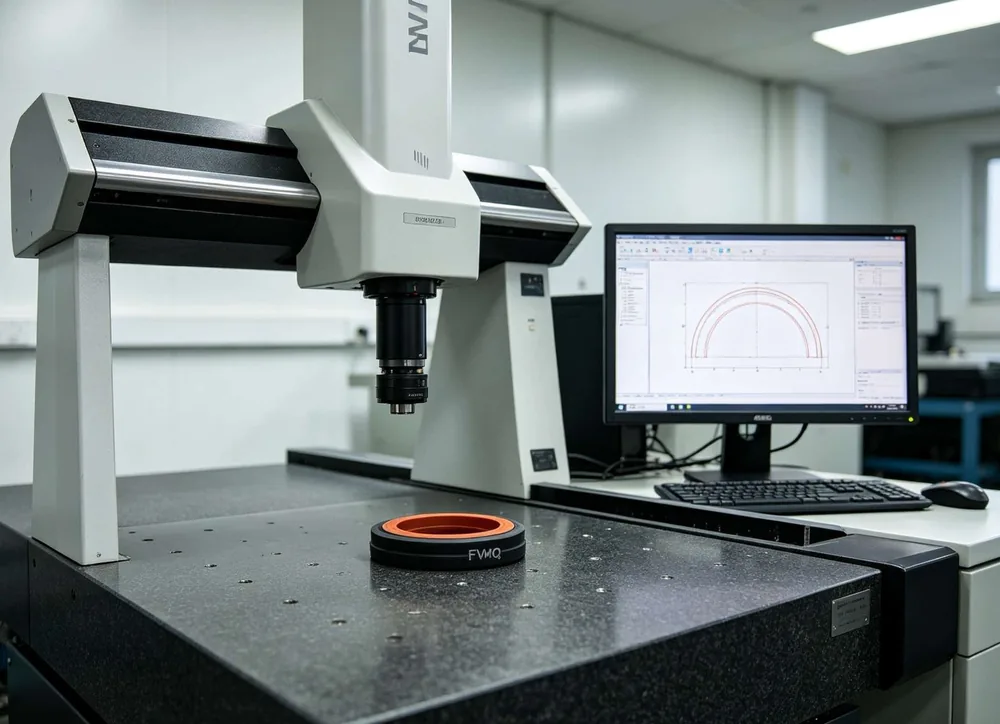
Medical tolerances are small, so the measuring instrument's own error matters. We verify critical dimensions on a CNC video measuring machine whose stated maximum permissible error is ≤ (3+L/200) µm on X/Y and ≤ (5+L/200) µm on Z (L in mm) — we quote the full formula, not a single "±0.003 mm" threshold, because a 300 mm measurement carries ±4.5 µm, not 3 µm. A supplier who rounds measurement capability down to a single optimistic digit is, intentionally or not, under-reporting the error that will show up in your capability study. See our testing & measuring equipment page for the full instrument list.
What this means when you choose a supplier
| Ask for | What a strong answer looks like |
|---|---|
| Cleanroom evidence | ISO 14644 report plus an in-process environmental monitoring program |
| Biocompatibility | USP Class VI / ISO 10993 tied to your specific compound and process |
| Extractables / leachables | A planned E&L study, not a promise to "do it later" |
| Capability data | Real Cpk numbers, including the below-target ones and the corrective action |
| Measurement | Instrument MPE stated as a formula with its limits, not a single digit |
The molding is often the easiest step. The proof — that it stays clean, safe, stable and measurable over the life of the part — is where medical silicone projects are actually won or lost.
This note is part of the CYES Engineering Knowledge Center, where our engineers document the decisions behind real projects rather than republishing generic advice. For the process and capability detail behind the numbers above, see engineering evidence, Cpk & process capability and extractables & leachables testing. Planning a medical silicone part? Contact us for a DFM and validation review.
About the author
WANG MENG · LSR Process Engineer, CYES SILICONE. Fourteen years in liquid silicone rubber (LSR) injection molding and process validation — from mold-flow and gate design to cleanroom multi-cavity runs and IQ/OQ/PQ documentation. Notes written from the shop floor, not from a content calendar.