When a buyer compares silicone OEM quotes, the mold price is usually the first number they circle. But the mold is the one thing that keeps costing you — or saving you — for the entire life of the part. This note explains what "in-house tooling" actually changes, from the perspective of a mold shop we have run ourselves since 2004.
The hidden cost of an outsourced mold is broken responsibility
An outsourced mold looks cheaper on the quote, but it splits the two things that should never be split: the shop that makes the tool and the shop that runs it. When they are different companies, every cavity correction becomes a negotiation, every revision waits for a new quote, and when a mold wears or fails there is no single party accountable for its full life. In our experience the initial saving is usually recovered several times over in delays, rework and the arguments about whose fault it is.
1. Traceability: one place, one answer
In-house tooling means the mold number, drawing revision, steel grade and material certificate all live in the same system as the production records. When a dimension drifts, we can trace it to the tool, the revision and the batch — not to a vendor's filing cabinet two cities away. That traceability is what makes a first-article inspection and a capability study actually mean something. See quality documents for the traceability behind our own records.
2. Iteration speed: days, not weeks
A silicone part rarely survives first contact with reality unchanged — the seal lip needs 0.05 mm more, the gate position moves, the flash needs a shut-off adjustment. With the mold shop on the same floor, a cavity change is cut and re-tried in days. Sent out to an external shop, the same change waits for a quote, a schedule slot and shipping. In a project where the clock is the customer's launch date, that difference is the difference.
3. The tooling itself, and what it can actually hold
"In-house" only matters if the tooling is good enough to trust. Ours is, and we state the numbers with their limits:
| Capability | Value | What it means |
|---|---|---|
| High-speed CNC | MAKINO 24,000 RPM, ±0.008 mm | General mold-cavity machining |
| Slow-wire EDM | Mitsubishi, ±0.003 mm fine features | Sharp corners, deep slots, fine detail |
| LSR shut-off / gate | ±0.005 mm | Cold-runner sealing surfaces, zero flash |
| Mirror finish | Ra 0.02 µm | Mirror-polished sealing and cosmetic surfaces |
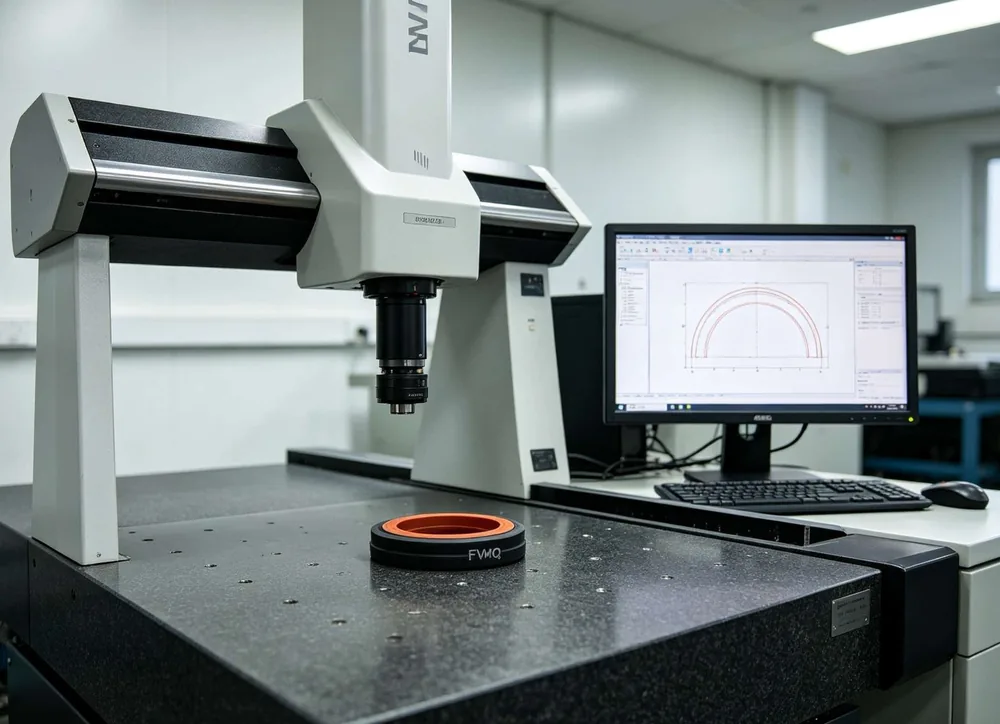
| Verification | ZEISS CONTURA CMM + video MPE ≤ (3+L/200) µm (X/Y) | Cavity checked against CAD before production |
The steel matters too. We machine S136 / NAK80 for corrosion-resistant, high-polish cavities and P20 for general work — and we plan mold life by steel grade, not by guesswork: our LSR cold-runner tooling in S136 / NAK80 is planned and validated to 500,000+ shots, and general-purpose P20 tooling is specced for shorter runs. Every mold is validated through a controlled T1 / T2 / T3 trial sequence before it enters production, so the tool that ships your parts is proven, not just delivered.
4. Lifetime responsibility
This is the point most buyers miss until year three. A silicone mold wears. When the mold shop and the molder are the same company, lifetime maintenance and repair are part of the deal — we have run in-house tooling work since 2004, across 100,000+ cumulative tooling operations, including cavity modifications and repairs on tools that are years old. When they are separate companies, the "lifetime" quietly becomes "until the warranty ends."
What to ask any OEM supplier about tooling
| Ask | Why it matters |
|---|---|
| Is the mold shop yours, or a subcontractor? | Determines who is accountable for the tool's full life |
| Show me a cavity modification you did recently | Proves iteration capability, not just new-mold claims |
| What steel, and what is the planned mold life? | Steel grade and planned life reveal whether the price is honest |
| How is the mold verified before production? | T1/T2/T3 trials and CMM/video verification vs. "trust us" |
| Who repairs it in year three? | Lifetime responsibility is the real cost of the mold |
A mold quote is the price of the tool. In-house tooling is the price of the tool plus who is accountable for it for the next ten years. That second number is the one that decides your project.
This note is part of the CYES Engineering Knowledge Center. For the full tooling capability, see tooling & engineering, and for how we verify what a mold can hold, see testing & measuring equipment. Have a part you need tooled? Contact us for a DFM review.
About the author
ZHOU GUI FENG · Mold Engineer, CYES SILICONE. Twelve years in silicone mold engineering and LSR molding — from tooling design and process setup to capability studies and validation documentation. Notes written from the shop floor, not from a content calendar.