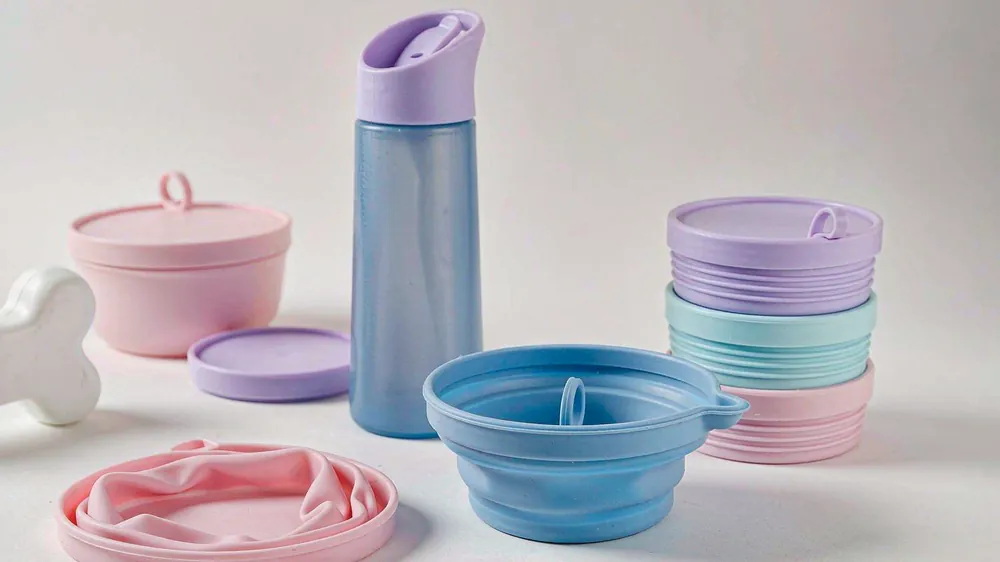
A collapsible silicone bowl packs flat but has to open into a stable, watertight dish. The engineering lives in the fold geometry — how the sidewall flexes without cracking after thousands of cycles. Here is what to get right.
The Fold Geometry Is the Product
Collapsible bowls use a stepped or corrugated sidewall that compresses like an accordion. Each step needs a thin, flexible hinge section between thicker, stiffer wall segments. The hinge is molded thinner than the wall, so the bowl folds at the hinge rather than creasing randomly. Get the wall thickness and hinge radius right and the bowl survives thousands of fold cycles; get them wrong and it cracks on the first trip.
Material and Durometer
Specify food-grade silicone at 50A – 60A. Softer than 50A and the bowl flops when filled with water; harder than 60A and the hinge is too stiff to fold. Platinum-cured, food-grade compound keeps the bowl safe for drinking water and easy to clean.
Watertightness and the Base Ring
A separate rigid base — usually a plastic or metal ring — is overmolded or press-fit into the bottom to keep the bowl from tipping. For a one-piece all-silicone design, a thick, weighted base section works, but it adds weight. Decide early: two-piece (silicone bowl + rigid ring) is lighter and sturdier; one-piece is simpler to mold and clean.
| Decision | Option A | Option B |
|---|---|---|
| Construction | Two-piece (rigid base ring) | One-piece all-silicone |
| Durometer | 50A – 60A sidewall | Same range for the hinge |
| Fold cycles | 5,000+ with tuned hinge | Depends on hinge radius |
| Weight | Lighter | Heavier |
| MOQ | from 500 pcs | Size and ring affect cost |
Testing Before You Ship
We fold-test every collapsible bowl design at the sampling stage — repeated open/close cycles, a water-fill stability test, and a leak check at the folded seam. Ask your supplier for a fold-cycle test report, not just a sample. This is the single most useful document for a collapsible bowl.
The hinge section is the whole product. Thin it too much and it tears; leave it too thick and the bowl won’t fold. Tune it once, test it to 5,000 cycles, and the design is done.
See our pet products manufacturing page, or send your travel bowl brief.
About the author
ZHOU GUI FENG · Mold Engineer, CYES SILICONE. Twelve years in silicone mold engineering and LSR molding — from tooling design and process setup to capability studies and validation documentation. Notes written from the shop floor, not from a content calendar.