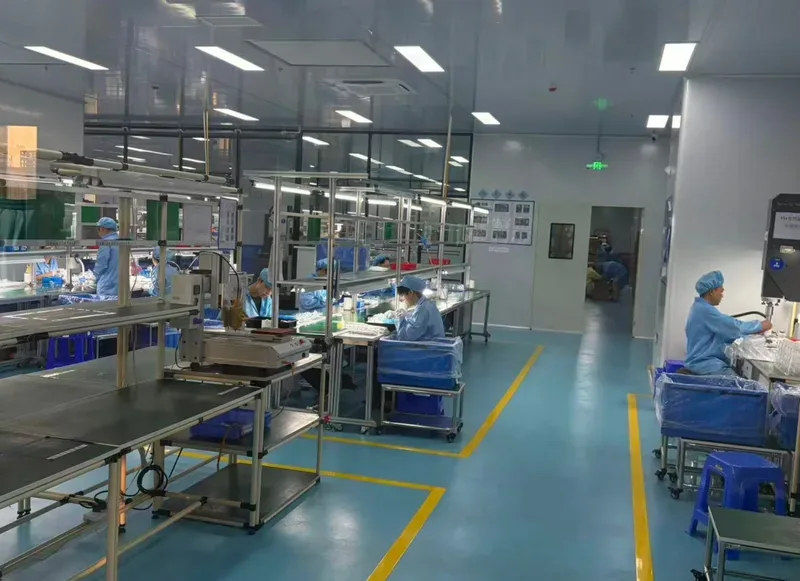
Not all "silicone factories" are the same. Two suppliers can both offer custom silicone parts, yet differ completely in cleanroom capability, quality system and compliance evidence. That difference rarely matters for a phone stand — and it matters enormously for a teether, a feeding bowl or anything that touches food or skin. Here is how to tell the two apart, and when it actually matters.
TL;DR — A consumer-grade factory is built for speed and volume on low-risk parts like promotional items and phone cases. A medical-grade factory adds an ISO Class 7 cleanroom, an ISO 13485 quality system and per-material compliance evidence — the audit-based systems that matter when a part touches food, mouth or skin. If your product carries any safety obligation, verify the cleanroom and the quality system, not just the machine list.
Two Kinds of Silicone Factory
A consumer-grade factory is optimized for speed and volume on low-risk, non-contact products: promotional items, phone cases, desk accessories. A medical-grade factory adds the infrastructure for safety-critical work: an ISO Class cleanroom, an ISO 13485 quality management system, and per-material compliance testing. The equipment may look similar in a photo — the systems behind it are not.
What Actually Changes
| Factor | Consumer-grade line | Medical-grade facility |
|---|---|---|
| Cleanroom | Typically none | ISO Class 7 cleanroom for molding |
| Quality system | ISO 9001 (often) | ISO 9001 + ISO 13485 |
| Food-contact testing | Often a single generic certificate | FDA / LFGB / 21 CFR 177.2600 per material |
| Child / toy safety | May not be offered | EN 71 testing where the product requires it |
| Process control | Visual / basic QC | Cpk-monitored processes (1.24–1.68) |
| Tolerances | Looser, cosmetic | Precision to ±0.008 mm |
| Traceability | Batch-level, limited | Material, lot and report traceability |
When Consumer-Grade Is Fine
If your product never touches food, never goes in a mouth and carries no safety obligation — a promotional wristband, a cable tie, a desk mat — a competent consumer-grade factory can be the right cost choice. You pay for the quality you actually need, and nothing more.
When You Need Medical-Grade
- Baby feeding and teething — teethers, pacifiers, snack cups, spoons. These go in a child's mouth daily.
- Food contact — bakeware, kitchen utensils, storage lids, pet bowls and lick mats.
- Personal care and wellness — anything applied to skin or used on the body.
- Medical and safety components — fluid-path parts, seals and diaphragms where failure is not an option.
The common thread is safety sensitivity. In these categories, the buyer's real question is not "who makes it cheapest" but "who can prove it is safe and consistent." A cleanroom and ISO 13485 are the strongest available answer — because they are audit-based systems, not marketing claims.
For baby, food-contact and body-contact products, treat the factory's cleanroom scope and quality system as part of the product specification — not an optional upgrade. Ask for the certificate, the cleanroom scope and the material-level test report, and confirm they cover your exact product and market.
Questions That Separate the Two
- "Can you share the ISO 13485 certificate number and the cleanroom classification?" — a medical-grade facility answers immediately.
- "Is the FDA / LFGB report per material, and can it be refreshed for my formulation?" — not a one-time generic paper.
- "Can you provide Cpk or capability data for my part?" — a consumer-grade line usually cannot.
- "What is your post-cure and residual-volatile process?" — this is what drives LFGB and odor performance.
- "Who holds the design and tooling records, and can I audit on-site?"
Red Flags: A Consumer-Grade Factory Posing as Medical-Grade
Many factories market "medical-grade" and "FDA / LFGB approved" without the systems behind the words. A few quick checks separate a real facility from a marketing page:
- They lead with ISO 9001 and stay silent on ISO 13485. ISO 9001 is a general quality system; medical-grade work is governed by ISO 13485. A factory that never names 13485 is signaling a consumer-grade line.
- No cleanroom class is stated. "Dust-free workshop" is not a classification. Ask for the ISO 14644 class — for example, ISO Class 7 — and the certificate that names it.
- No process data. "Strict QC" without a single Cpk, tolerance or GR&R number is a claim, not evidence. A capable factory can share capability studies in hours, not weeks.
- Compliance words without test reports. "FDA approved" and "LFGB compliant" are statements. Ask for the per-material report number and the accredited lab that issued it.
- Inconsistent numbers across pages. If the employee count, founding year or factory size changes from one page to the next, treat every other number on the site as unverified.
We publish our numbers for a reason. Our ISO 13485 certificate carries number 04724Q10000602 (CMD), our ISO 9001 number is 61120Q012, the cleanroom is ISO Class 7, and our Cpk capability studies (1.24–1.68) are all on this site — verifiable, not decorative.
Medical-Grade vs Consumer-Grade at a Glance
| Your product | Recommended facility |
|---|---|
| Promotional gifts, cable accessories, desk items | Consumer-grade |
| Phone cases, electronic accessories | Consumer-grade or precision |
| Pet bowls, lick mats, treat molds | Medical-grade (food-contact) |
| Kitchenware, bakeware, storage | Medical-grade (food-contact) |
| Baby teethers, pacifiers, feeding | Medical-grade |
| Medical, fluid-path and safety components | Medical-grade |
CYES SILICONE runs an ISO Class 7 cleanroom limited to designated medical LSR molding and packaging under ISO 13485. Baby, kitchenware and pet lines are produced under ISO 9001 with FDA / LFGB / 21 CFR 177.2600 material testing and project-defined hygiene controls — not in the Class 7 area. Process capability is monitored to Cpk 1.24–1.68. Tell us your product and target market — we'll confirm the compliance scope you actually need.
About the author
DENG FENGYUN · Measurement Engineer, CYES SILICONE. Sixteen years in silicone testing, FDA / LFGB / RoHS compliance and quality systems — from CMM and video measuring programs to extractables and biocompatibility test plans. Notes written from the shop floor, not from a content calendar.