100,000 / month
Sustained monthly production of CPAP mask cushion seals.
A European respiratory-device manufacturer needed a CPAP mask cushion seal that holds a reliable face seal night after night — in Shore 40A medical-grade LSR, molded on multi-cavity cold-runner tooling, at a sustained volume of 100,000 units per month with ≥99% first-pass yield. The client is anonymized here under NDA; the production numbers and quality results are real.
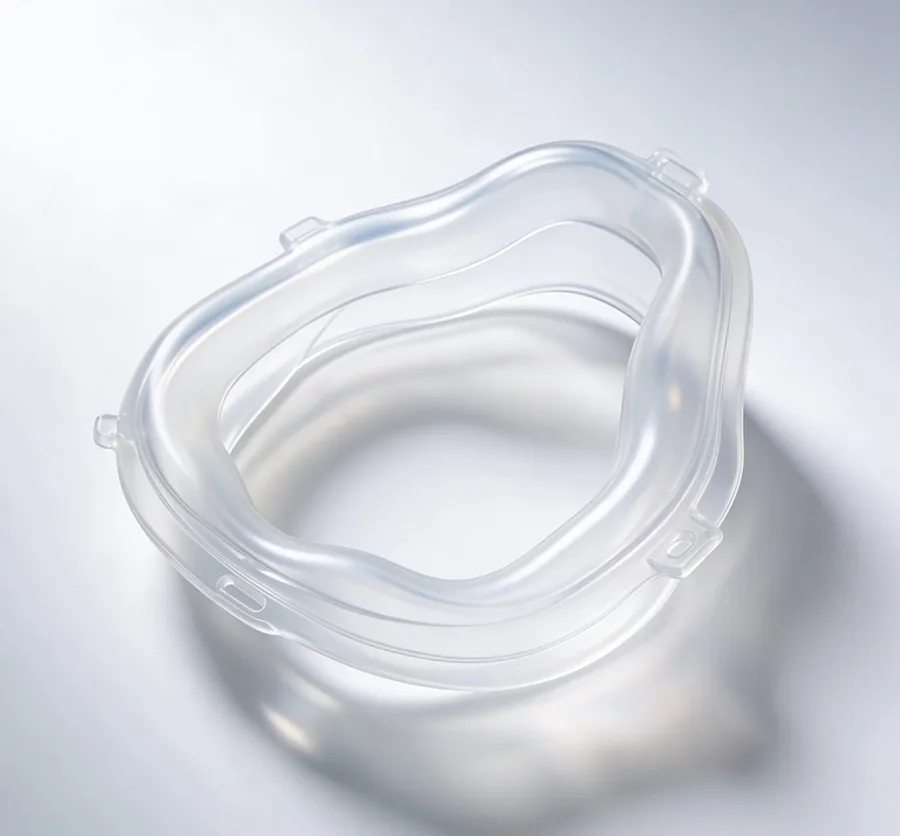
A CPAP (continuous positive airway pressure) mask cushion is the single most personal component of sleep-apnea therapy. It sits directly against the patient's face for seven or more hours every night, sealing a pressurized air stream without leaking, without leaving marks, and without irritating the skin. The cushion has to be soft enough to conform to the contours of the face, yet resilient enough to spring back to shape after every removal — for months of nightly use.
The engineering tension is real: a softer material seals and conforms better, but is harder to mold with consistent geometry at high volume; a harder material molds more predictably, but seals and wears less comfortably. We worked with the customer to land on a Shore 40A medical-grade liquid silicone rubber (LSR) — soft enough for prolonged, comfortable skin contact, while still moldable to a repeatable sealing-lip geometry on multi-cavity tooling.
Because the part is a breathing-therapy component, biocompatibility and cleanliness are non-negotiable. Every cushion is molded in an ISO 14644-1:2015 Class 7 cleanroom from USP Class VI / ISO 10993 compliant material, with full batch traceability from raw material to shipment. The client's identity is protected under NDA, but the program itself — the volumes, the yield, the process — is documented and real.
Every number below is a real production result from this running program, not a marketing description.
Sustained monthly production of CPAP mask cushion seals.
First-pass yield held at or above 99% with full batch traceability.
Medical-grade platinum-cured liquid silicone for soft, conformable skin contact.
Molded in an ISO 14644-1:2015 Class 7 cleanroom on multi-cavity cold-runner tooling.
We use this seven-field structure for every documented project so you can compare like-for-like.
| Project field | This case |
|---|---|
| 1 · Customer Application | CPAP mask cushion seal for a European respiratory-device manufacturer (client anonymized under NDA) |
| 2 · Engineering Challenge | A soft sealing lip that must stay dimensionally precise across high volumes, and remain biocompatible for prolonged skin contact |
| 3 · Material Selection | Shore 40A medical-grade platinum-cured LSR, USP Class VI / ISO 10993 compliant |
| 4 · Manufacturing Process | Cold-runner LSR injection molding on multi-cavity tooling in an ISO Class 7 cleanroom |
| 5 · Quality Control | First-article approval (FAI), dimensional and Shore hardness checks, and full batch traceability from raw material to shipment |
| 6 · Measured Results | Sustained volume of 100,000 units per month at a first-pass yield of ≥99% |
| 7 · Final Application | CPAP / sleep-apnea therapy mask cushion |
High-volume medical molding is less about a single clever trick than about getting every stage of the process repeatable — and keeping it that way at 100,000 units a month.
Hardness is the first decision, because it shapes everything downstream. Too soft and the sealing lip collapses under the mask's clamping force; too hard and the cushion stops conforming to the patient's face. Shore 40A LSR sits in the sweet spot for CPAP cushions — soft and compliant, but with enough structure to demold cleanly and hold a repeatable geometry. We validated the choice against the customer's sealing-force and skin-contact requirements before committing to tooling.
At 100,000 units a month, single-cavity molding is not an option, and neither is a conventional hot-sprue feed that would cure a thick runner block on every shot. We use multi-cavity cold-runner tooling: the LSR stays below cure temperature in the feed channel and only cures inside each cavity. This cuts cured-runner waste to near zero, shortens cycle time, and — critically for a high-cavitation seal — keeps the fill balanced so every cavity produces an identical cushion.
A breathing-therapy component has to be clean, not just accurate. Molding and packing take place in an ISO Class 7 cleanroom, with robotic part handling that removes the manual contact and particulate risk a face-worn part cannot tolerate. This is the same controlled environment we use across our medical LSR work.
No sample ships until it passes first-article inspection (FAI). In production, we run dimensional checks and Shore hardness checks on the sealing lip, and link every batch from raw-material lot through mold, machine, operator and shipment. That full traceability is what turns "≥99% yield" from a claim into a number we can stand behind.
The hard part of a 100,000-unit monthly program is not hitting 99% once — it is holding it month after month as material lots, operators and mold wear all shift. We sustain the yield through controlled process parameters, regular mold maintenance, and SPC-style monitoring of the critical dimensions, so the cushion the patient receives in month twelve matches the one from month one.
If you are sourcing a medical or breathing-therapy silicone component, this case demonstrates the three capabilities that matter most at volume. First, the ability to hit and hold a demanding first-pass yield across high monthly volumes — a far harder task than producing a good one-off sample. Second, a genuine medical-grade cleanroom environment with full lot traceability, not a repurposed general-purpose line. Third, the engineering discipline to choose the right material and tooling approach up front, so the part is manufacturable at scale rather than just prototypable.
We can apply the same approach to your CPAP, respiratory or medical silicone component — whether it is a mask cushion, a seal, a valve or a custom LSR part. The starting point is always a material-and-DFM review, so the risks are found before tooling is committed.
A real, running production program — Shore 40A medical-grade LSR molded on multi-cavity cold-runner tooling in an ISO Class 7 cleanroom, at 100,000 units per month with ≥99% first-pass yield and full batch traceability.
The client's identity is withheld under NDA, so we cannot name the OEM. The yield figure is a production first-pass yield, not a statistical process-capability index; for a formal Cpk study on a specific dimension, see our medical LSR diaphragm case.
See the Cpk study (LSR diaphragm) Medical & Healthcare capability