Our Manufacturing Process
A transparent nine-stage process that takes your silicone product from initial idea through DFM, tooling, first-article validation and sample approval to finished, shipped goods.
Inquiry & Design Consultation
Send us your drawings, samples or even a rough idea. Our engineers review feasibility, recommend materials and provide a detailed quotation within 24 hours.
3D Design & DFM Review
We create or refine 3D models and run a design-for-manufacturing (DFM) analysis to optimize wall thickness, undercuts and tolerances for cost and quality.
Mold & Tooling Fabrication
Precision molds are CNC machined and mirror-EDM finished in-house to ±0.01 mm cavity tolerance, then assembled with cooling, ejection and venting systems.
First-Shot Trial & FAI
The mold is trialed and first articles are measured in a full First Article Inspection — dimensions, hardness and visual — so we catch geometry, flash and fill issues before volume production.
Sample Validation & Approval
Approval samples are shipped for your review and sign-off. We iterate the mold or process until the samples match your specification before committing to production.
Material Compounding & Preparation
We select food-grade or medical-grade silicone compounds, add color and cure agents with Pantone-matched ΔE ≤ 1.5 accuracy, and verify each batch against certification requirements.
Molding — Compression or LSR Injection
Parts are formed using compression molding for solid silicone, or liquid silicone injection with cold-runner systems and ±0.1% shot-weight control for high-precision, high-purity components.
Post-curing, Trimming & Finishing
Products are post-cured to reduce volatiles, de-flashed, and finished with printing, laser marking or assembly as required by your specification.
Quality Inspection, Packaging & Shipping
Every batch passes IQC, IPQC and OQC inspection with statistical process control on critical dimensions, then is packaged to your requirements and shipped with full export documentation.
Stage-Gate Development, From Concept to PPAP
Our nine production stages are organized into a six-phase product development framework — Concept, Design, EVT, DVT, PVT and Mass Production — matching the industry-standard engineering vocabulary your team already uses. Each gate must pass before the next begins, so you can track a project against familiar milestones.
| Phase / Gate | What happens | Exit criterion |
|---|---|---|
| Phase 0 · Concept & Feasibility (G0) | Inquiry, requirement capture, material recommendation, feasibility review (Stage 1) | Approved quote, DFM feasibility and material plan |
| Phase 1 · Design & DFM (G1) | 3D design or reverse engineering, DFM analysis, mold-filling simulation (Moldflow), scientific shrink compensation and thermal simulation, tooling plan (Stage 2) | DFM report and mold design sign-off |
| Phase 2 · EVT — Engineering Validation (G2) | Rapid prototyping (SLA/DLP, vacuum casting, fast aluminum mold), mold fabrication, first-shot trial, First Article Inspection (Stages 3–4) | FAI report confirms first articles meet engineering spec |
| Phase 3 · DVT — Design Validation (G3) | Sample validation, reliability and functional testing, regulatory compliance verification, material verification, customer sign-off (Stage 5) | Golden sample approved and design frozen |
| Phase 4 · PVT — Process Validation & Pilot (G4) | Material compounding, pilot production run, process capability study (Cpk), measurement systems analysis (Gage R&R / MSA) (Stages 6–7) | Pilot run meets Cpk and yield targets |
| Phase 5 · Mass Production & PPAP (G5) | Ramp-up, IQC/IPQC/OQC, PPAP documentation, shipment (Stages 8–9) | PPAP package approved and production released |
FAI, Gage R&R, Control Plan, PFMEA & PPAP — Documented Evidence
First Article Inspection (FAI)
Standard on every tooled project. The first article — the very first molded part from a new or revised mold — is fully measured against your drawing: critical dimensions, hardness, visual appearance and material properties. An FAI report documents each measurement against tolerance before volume production is released.
Gage R&R / Measurement Systems Analysis
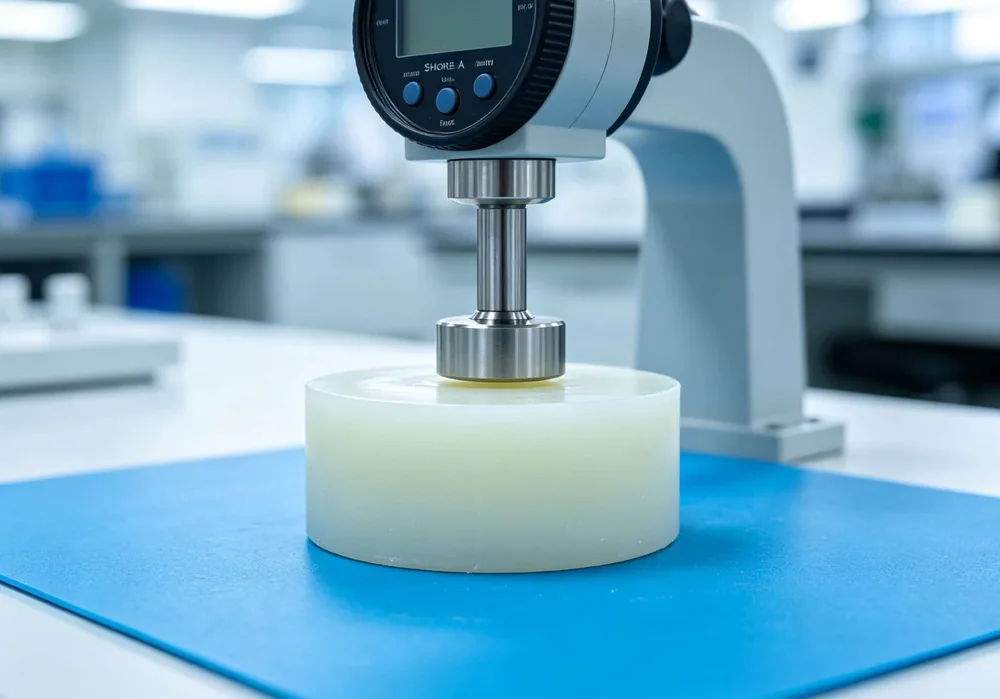
Before a critical dimension is trusted for acceptance decisions, our calibrated measuring equipment — calipers, Shore durometers, tensile testers, optical and vision systems — is assessed for repeatability and reproducibility (Gage R&R) as part of a measurement systems analysis. This confirms the gage, not just the process, is capable of reliable pass/fail calls.
Control Plan & PFMEA
For programs that require them, we build a documented control plan (what is measured, how often, by whom and the reaction plan) and a process FMEA (failure modes, effects and controls) so that quality is defined before production, not discovered after. These are delivered as part of PPAP when a program calls for it.
PPAP — Level 3 Where Requested
For automotive and other regulated programs we deliver a Production Part Approval Process package to Level 3 with a complete document set: design records, engineering change notes, dimensional results (with Cpk), material and performance test results, process flow diagram, PFMEA, control plan, measurement systems analysis (Gage R&R), capability studies and a production sample. Level 2 or 4 available on request.
FAI is standard on every tooled project. Control plan, PFMEA and PPAP documentation are delivered to Level 3 (design records, dimensional results, material certifications, process flow diagram, PFMEA, control plan, Gage R&R and capability data) when your program calls for it — no need to ask a separate vendor.
Dive deeper: EVT / DVT / PVT validation phases · PPAP & quality documentation · product development service.
EVT / DVT / PVT — What Each Validation Phase Verifies
Each validation phase has defined inputs, test items, acceptance criteria, a customer approval gate and a deliverable document. This is what we actually execute — no stage is skipped or assumed.
Phase 2 · EVT — Engineering Validation Test
| Item | Detail |
|---|---|
| Engineering inputs | Signed drawing / CAD, DFM report, mold design, material specification |
| Test items | First-shot mold trial; first-article dimensional measurement; Shore A hardness; visual/flash/fill review; weight or shot-size check |
| Acceptance criteria | First article meets drawing tolerances; no short-shot, flash, sink or demolding defects; hardness within specified range |
| Customer approval node | FAI report issued and reviewed before any sample ships |
| Deliverable document | First Article Inspection (FAI) report |
Phase 3 · DVT — Design Validation Test
| Item | Detail |
|---|---|
| Engineering inputs | Approved EVT samples, design specification, customer test plan (where provided), regulatory requirements |
| Test items | Functional testing; reliability/life testing; regulatory compliance verification (food-contact, medical, ROHS, REACH); material verification and migration testing |
| Acceptance criteria | Part meets functional and reliability requirements in use; material complies with the applicable standard for the specific part and grade |
| Customer approval node | Golden sample approved and design frozen before tooling is committed to volume |
| Deliverable document | Design validation report, material compliance test results, golden-sample sign-off |
Phase 4 · PVT — Process Validation Test
| Item | Detail |
|---|---|
| Engineering inputs | Frozen design, production tooling, pilot-run plan, control plan draft |
| Test items | Pilot production run at production intent; process capability study (Cpk); measurement systems analysis (Gage R&R); yield and cycle-time review |
| Acceptance criteria | Pilot run meets Cpk and yield targets agreed with the customer; the gage, not just the process, is proven capable |
| Customer approval node | Pilot results reviewed and production process released for ramp |
| Deliverable document | Process capability report (Cpk), Gage R&R study, control plan, PFMEA |
Silicone & Related Materials We Work With
Food-grade Silicone
FDA & LFGB compliant for kitchenware and food-contact products.
Medical-grade Silicone
Bio-compatible, sterilizable material for healthcare devices.
Solid Silicone Rubber (HCR)
High-consistency rubber for seals, gaskets and industrial parts.
Liquid Silicone (LSR)
High-precision, high-purity injection-grade material.
Fluorosilicone (FVMQ)
Fuel and solvent resistant for automotive, aerospace and sealing applications.
Engineering Plastics
PC, PA66 and PBT for multi-material overmolding with silicone.
Three-stage Inspection at Every Step
Quality is verified continuously, not just at the end. Our QC laboratory performs in-house testing throughout production.
- IQC — incoming material inspection
- IPQC — in-process quality checks
- OQC — final outgoing inspection
Start Your Project With a Free Quote
Tell us about your product and receive a quotation with lead time within 24 hours.
Get a Free Quote