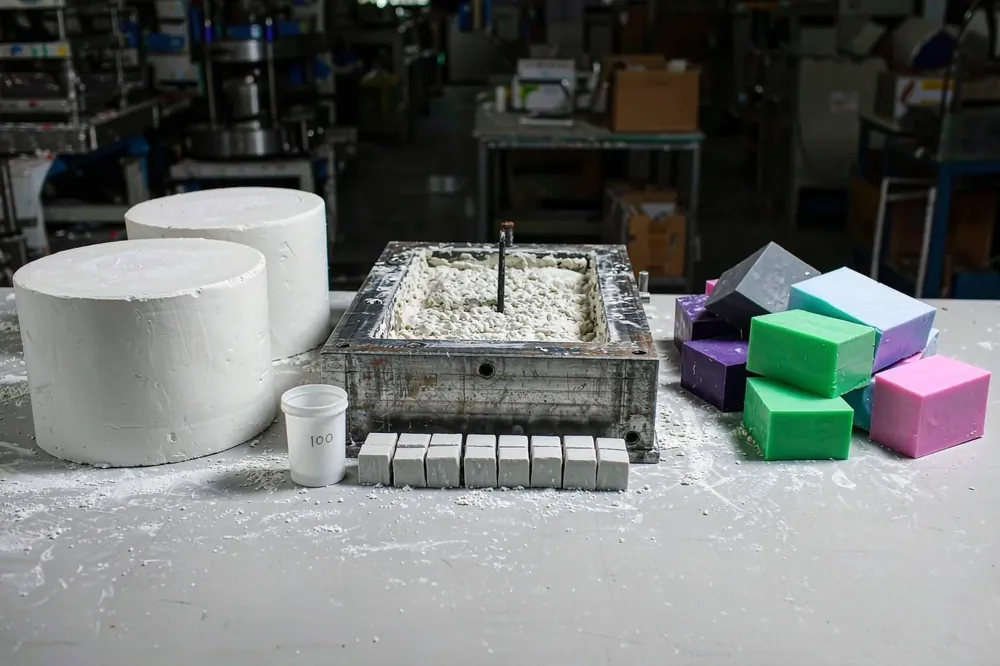
Silicone wins on heat resistance, food safety, and long-term durability — it handles -60°C to 230°C, carries the broadest food-contact certifications, and resists UV and ozone for years. TPE wins on cost, recyclability, and its ability to bond directly onto rigid plastics in a two-shot mold. Rubber (natural/EPDM) is the workhorse for tires, seals, and high-abrasion parts but degrades outdoors and is rarely food-safe. The right choice depends on whether you need heat tolerance, food contact, or cheap overmolding. This guide lays out the trade-offs so you can decide in minutes.
The three materials at a glance
| Property | Silicone | TPE | Rubber (NR/EPDM) |
|---|---|---|---|
| Continuous temp range | -60°C to 230°C | -40°C to 120°C | -50°C to 100°C |
| Food-contact certifications | Excellent (FDA, LFGB) | Limited (some grades) | Rarely food-safe |
| UV / ozone / weather resistance | Excellent | Fair (varies by grade) | Poor (cracks, degrades) |
| Relative material cost | Higher | Lower | Lowest (by weight) |
| Overmold onto rigid plastic | Needs primer/mechanical bond | Excellent (chemical bond) | Poor |
| Recyclability | Poor (specialized) | Good (thermoplastic) | Poor (thermoset) |
| Typical applications | Kitchenware, baby, medical, seals | Grips, soft-touch, toys, gaskets | Tires, belts, hoses, vibration mounts |
When silicone is the clear winner
Choose silicone when any of these apply:
- Food or beverage contact — kitchen utensils, baking mats, baby bottle nipples, pet bowls. Silicone's FDA/LFGB certification record is unmatched.
- High heat — oven-safe bakeware, coffee machine parts, steam-resistant seals. Silicone holds up to 230°C where TPE softens and rubber degrades.
- Medical or body contact — silicone is biocompatible and can meet ISO 10993 for medical devices.
- Outdoor or long-life parts — silicone resists UV and ozone, so it won't crack or yellow like rubber.
- Baby products — the default material for teethers, nipples, and feeding accessories.
Silicone is the premium elastomer. It costs more per kilogram, but for food, heat, and medical applications it's usually the only material that meets the requirements.
When TPE is the smart choice
Choose TPE (thermoplastic elastomer) when:
- You need soft-touch overmolding — TPE chemically bonds to PP, PC, ABS, and other rigid plastics in a two-shot mold, making soft-grip handles, toothbrush grips, and tool handles cheap and fast.
- Cost is the top priority — TPE is cheaper per kilogram and cycles faster, so per-part cost is lower for high-volume consumer goods.
- Recyclability matters — TPE is thermoplastic and fits standard recycling streams better than silicone.
- You don't need high heat — if the part never exceeds ~100°C, TPE's temperature limit is fine.
TPE's weakness is temperature and long-term stability. It softens above 120°C and can lose shape or grip over repeated heat cycles.
When rubber still makes sense
Natural rubber and EPDM remain the right choice for heavy-duty industrial applications:
- High abrasion — tires, conveyor belts, soles where wear resistance matters more than food safety.
- Dynamic fatigue — rubber's excellent tear and flex resistance suits vibration mounts, engine mounts, and flexing hoses.
- Lowest raw cost — for non-food, non-outdoor bulk parts, rubber is cheapest by weight.
Rubber's weakness is weather and food. It degrades in UV and ozone, and most rubber is not food-contact approved.
Head-to-head: the numbers that decide
| Decision factor | Best choice | Why |
|---|---|---|
| Food/baby contact | Silicone | Broadest FDA/LFGB certification, inert, odorless |
| High heat (>150°C) | Silicone | Holds to 230°C; TPE and rubber fail |
| Soft grip overmold on plastic | TPE | Chemical bond, fast two-shot molding |
| Outdoor / UV exposure | Silicone | No cracking or yellowing |
| Lowest part cost, high volume | TPE | Cheaper material, faster cycle |
| High abrasion / flexing | Rubber | Best tear and wear resistance |
| Recyclability required | TPE | Thermoplastic, standard streams |
The cost question: cheaper up front vs cheaper over time
TPE is cheaper per kilogram and cycles faster, so the per-part price is usually lower. But cost isn't only the material price:
- Silicone's durability means fewer returns and replacements for food and outdoor products.
- Compliance — if a cheaper TPE fails food-contact testing, the "savings" turn into a costly recall.
- Tooling — silicone (LSR) molds cost more than TPE injection molds, but for low-volume compression, silicone tooling can be cheaper.
The right question isn't "which material is cheaper?" — it's "which material meets the requirement at the lowest total cost, including returns, compliance, and lifetime?"
Molding differences you should know
- Silicone — compression molding (low cost, low volume) or LSR injection (high volume). LSR molds are expensive but last 500,000–1,000,000+ shots.
- TPE — standard thermoplastic injection molding. Fast cycles, lower tooling cost, easy two-shot overmolding.
- Rubber — compression or transfer molding, plus vulcanization. Cycle times are longer, and scrap cannot be re-melted.
FAQ
Q: Is silicone better than TPE?
A: It depends on the application. Silicone wins on high-temperature resistance, food safety, and long-term durability. TPE wins on cost, overmolding onto rigid plastics, and recyclability. For food-contact and high-heat products, silicone is usually the better choice.
Q: Is TPE food safe?
A: Some food-grade TPEs exist, but silicone has a much longer track record and broader certification coverage (FDA, LFGB) for food contact. If food safety is critical, silicone is the safer default.
Q: What temperature can silicone withstand?
A: Standard silicone typically withstands -60°C to 230°C continuously, with short excursions higher. TPE is generally limited to about -40°C to 120°C, and natural rubber to roughly -50°C to 100°C.
Q: Which is cheaper, silicone or TPE?
A: TPE is usually cheaper per kilogram and cycles faster in injection molding. But silicone's durability and temperature range can make it cheaper over the product lifetime, especially for food and medical applications.
Q: Can TPE be overmolded onto plastic?
A: Yes, and this is TPE's biggest advantage — it bonds easily to rigid thermoplastics like PP, PC, and ABS in a two-shot process. Silicone can also be overmolded but requires a primer or mechanical bond.
Q: Which is more durable, silicone or rubber?
A: Silicone outperforms natural rubber in UV, ozone, and weather resistance — rubber cracks and degrades outdoors, while silicone stays flexible for years.
Q: Is silicone recyclable?
A: Silicone is not easily recyclable through standard plastic streams — it is recycled through specialized silicone recycling programs. TPE, being thermoplastic, is more readily recyclable.
See our Silicone Material Guide for a deeper dive into silicone grades, or ask which material fits your product with a free engineering review.