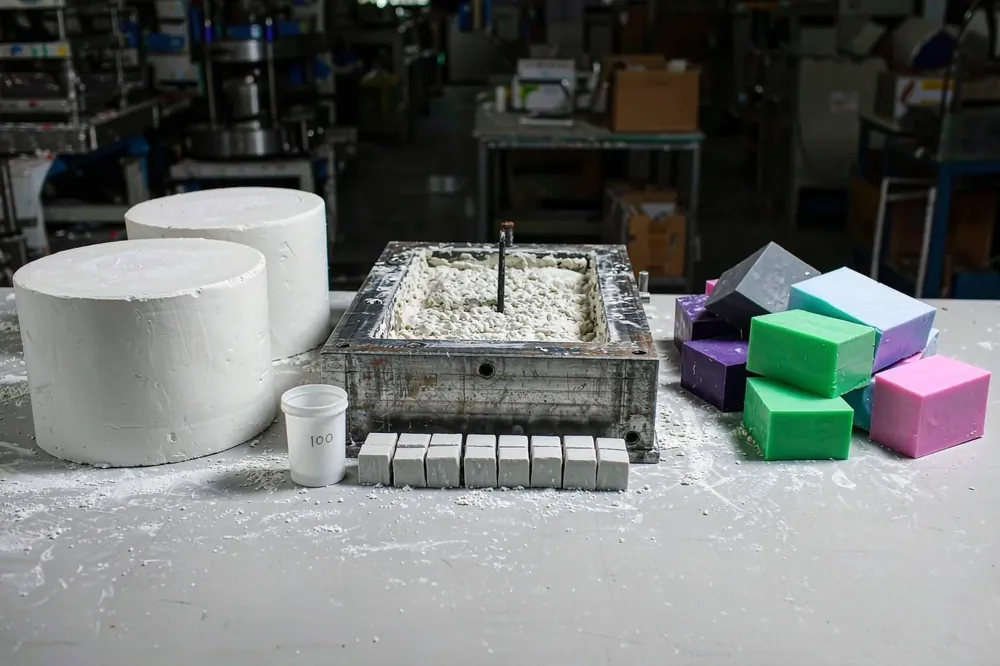
Compression molding is cheaper for short runs, large parts, and low-MOQ consumer products (typically from 100–500 pieces). LSR (liquid silicone rubber) injection molding is cheaper for high-volume precision parts (typically 5,000+ pieces), tight-tolerance components, overmolded inserts, and cleanroom medical products. For order volumes between 500–5,000 pieces, the decision is usually made by tolerance requirements, part geometry, and the cost of secondary operations — not just unit price.
Why this decision drives 60% of your total cost
For most buyers, the first "sourcing quote" they get is a unit price. They compare A factory's $0.80/pc against B factory's $0.75/pc and pick B. They rarely see that A quoted compression molding with $350 tooling and B quoted LSR injection with $6,500 tooling, and that B only hits $0.75 at 10,000 pieces. At 1,000 pieces, B's real landed cost is $7.25/pc.
The molding process choice determines:
- Tooling cost (×3 to ×15 difference)
- Unit price at your volume
- Dimensional tolerance (±0.05 mm vs ±0.20 mm)
- Secondary operations (deflashing, trimming, cleaning)
- Cleanroom capability (medical, food-grade)
- Material waste (runner scrap vs near-net shape)
This article gives you a decision framework that you can apply to any silicone part, not just what your factory recommends.
The two processes in one picture
| Attribute | Compression Molding | LSR Injection Molding |
|---|---|---|
| Material form | Solid pre-cut silicone slabs | Liquid two-component pump-fed |
| Cure time per shot | 60–180 seconds | 20–60 seconds |
| Typical cavity count | 1–4 | 4–64 |
| Tooling cost (simple part) | $500–$3,000 | $3,000–$15,000+ |
| Minimum practical volume | 100–500 pcs | 3,000–5,000 pcs |
| Tolerance on 50 mm part | ±0.15–0.25 mm | ±0.03–0.08 mm |
| Flash / deflashing required | Yes (hand or tumble) | Typically none |
| Material waste | High (trimming, flash) | Very low (no runner in LSR cold-runner) |
| Best part size | 20–300 mm | 2–150 mm |
| Overmolding onto inserts | Limited | Native capability |
| Cleanroom production | Possible | Standard (Class 7 common) |
| Lead time for tool | 7–15 days | 15–30 days |
Compression Molding: the workhorse for consumer goods
Compression molding presses a pre-measured slug of solid silicone into an open mold, then closes the platens and applies heat. It has been the dominant silicone process for 70 years, and it remains the right choice for:
1. Low-MOQ consumer products. Baby teethers, kitchen utensils, pet bowls, beauty applicators. At 100–500 pieces, the $3,000 LSR mold cannot be amortized. Compression tooling at $500–$1,500 is the only economic path.
2. Large or flat parts. Silicone baking mats 40 × 30 cm, roll-up pet mats, large phone pouches. LSR injection requires the material to flow through a gate; large flat parts create hard-to-fill weld lines and pressure imbalance. Compression spreads the material evenly.
3. Small-batch product testing. A brand testing a new teether shape on Amazon. Compression tooling takes 7–15 days; a single-cavity prototype mold is $800–$1,500. If the design fails, the loss is contained.
4. Multi-color or multi-hardness products. Two-shot compression is possible but slow. Overmolded keypads, multi-layer seals, and gradient hardness parts often work best in compression for low volumes.
Compression downsides: Flash on every part, manual deflashing, wider tolerance, harder to automate. A part that needs ±0.05 mm on a sealing lip will likely fail compression first-article inspection.
LSR Injection Molding: for precision and scale
Liquid silicone rubber is pumped from two containers (Part A + Part B with catalyst), mixed in the nozzle, and injected into a closed heated mold under high pressure. It cures in 20–60 seconds per shot. This is the process that makes 500 million baby nipples per year, 30 million keypad membranes, and 5 million medical catheters.
LSR is the right choice when:
1. Volume justifies it. At 5,000+ pieces, the $6,000 mold pays back in unit-price savings within 6–12 months.
2. Tight tolerance required. A sealing lip that must hold 0.5 bar vacuum, a medical connector that mates to a precision plastic housing, an optical lens that must focus light. LSR injection holds ±0.05 mm routinely.
3. Overmolding onto inserts. Silicone overmolded onto a metal spring, plastic button core, or fabric. LSR injection places the silicone precisely on the insert with zero flash.
4. Cleanroom is required. Medical LSR molding runs in ISO Class 7 or Class 8 cleanrooms. Compression can be cleaned, but automation in LSR injection reduces human contact, which is what cleanroom certification actually measures.
5. No secondary operations. If you want the part to come out of the mold ready to ship, LSR injection with a cold runner produces near-net-shape parts with zero deflashing.
LSR downsides: High tooling cost, long lead time, difficult to justify below 3,000 pieces, gate marks visible on parts (unless valve-gated cold runner), overkill for a simple spatula.
The 500–5,000 piece gray zone
This is where most buyers get burned. Let's use a real example: a silicone facial mask applicator brush at 2,000 pieces.
Compression route:
- Tooling: $1,200 (single cavity)
- Unit price: $1.80
- Deflashing + cleaning: $0.30/pc
- Total at 2,000 pcs: $1,200 + $3,600 + $600 = $5,400 ($2.70/pc)
LSR injection route:
- Tooling: $6,500 (4-cavity cold runner)
- Unit price: $0.55
- No deflashing: $0
- Total at 2,000 pcs: $6,500 + $1,100 = $7,600 ($3.80/pc)
At 2,000 pieces, compression wins. At 10,000 pieces:
- Compression: $1,200 + $18,000 + $3,000 = $22,200 ($2.22/pc)
- LSR: $6,500 + $5,500 = $12,000 ($1.20/pc)
The crossover point for this part is around 4,000 pieces. Your factory should be able to calculate this for you — if they only quote one process, ask for the other.
Decision checklist for your part
Ask these five questions:
- What is your 12-month volume forecast? If unknown, assume 1,000 for safety.
- What tolerance does the mating part require? If ±0.20 mm is fine, compression works. If ±0.05 mm, LSR.
- Does it contact food or medical tissue? Both processes can comply, but LSR makes cleanroom certification easier.
- Does it need overmolding onto plastic, metal, or fabric? LSR is native; compression is possible but slower.
- What is your cash position on tooling? If $3,000 tooling is a hard cap, compression is the answer.
Overmolding, two-shot, and multi-material
A third option that most factories do not mention upfront: overmolding silicone onto engineering plastics (PC, ABS, PP, PA66, PBT). This is typically done via LSR injection in a 2-shot machine, or by placing pre-molded plastic inserts into the LSR mold. This is how premium keyboard keypads, waterproof connector seals, and soft-touch grips are made. CYES SILICONE provides this via LSR injection; engineering plastic injection is delivered through qualified partners with CYES managing DFM and quality.
Secondary operations: the hidden cost
Many buyers forget that the molded part is not the finished product. Budget 10–30% of unit price for:
- Hand deflashing
- Pad printing, laser marking, or UV printing
- Assembly (attaching a handle, packaging)
- Cleaning (IPA wash for medical parts)
- Visual inspection (AQL 1.5 / 2.5 sampling)
LSR injection reduces the deflashing line item to near zero but does not eliminate printing or inspection.
FAQ
Q: Can I start with compression and switch to LSR later?
A: Yes, but the part geometry must be designed for LSR from day one. Compression molds often produce parts with features (undercuts, thin walls, flash grooves) that do not translate to LSR gates. Tell your factory at DFM stage: "I expect to switch to LSR at 10,000 pieces."
Q: What is the cheapest way to test a new silicone product idea?
A: SLA appearance prototype (1–3 days) → rapid silicone sample from existing tooling or vacuum casting (3–7 days) → single-cavity compression mold (7–15 days) → production LSR or compression mold. CYES SILICONE offers all four steps in-house.
Q: What is the typical tooling cost for a simple silicone spatula?
A: Compression: $500–$1,500. LSR injection: $3,000–$8,000 depending on cavity count.
Q: How long does an LSR mold last?
A: A properly hardened steel LSR mold typically runs 500,000–1,000,000 shots before significant wear. Compression aluminum molds are typically 10,000–50,000 shots.
Q: Is LSR material itself more expensive than solid silicone?
A: Per kg, LSR is typically 20–40% more expensive than solid HCR silicone. But because LSR has near-zero waste (no runner scrap in cold-runner systems) and cycles 3–5× faster, the landed unit cost at high volume is usually lower.
Q: Can LSR injection make a 30 cm baking mat?
A: Not economically. LSR presses that large are rare, and the clamp force required is enormous. Compression is the standard process for flat large-format products.
Q: What is the minimum order for LSR injection?
A: Practically 3,000–5,000 pieces, because below that the mold cost cannot be amortized. Some factories will run LSR at 1,000 pieces if the part is very complex, but expect to pay a 2× unit price premium.
Compare both processes for your part in Custom Silicone Molding, or request a two-process quote and we'll show you the total cost, not just the unit price.