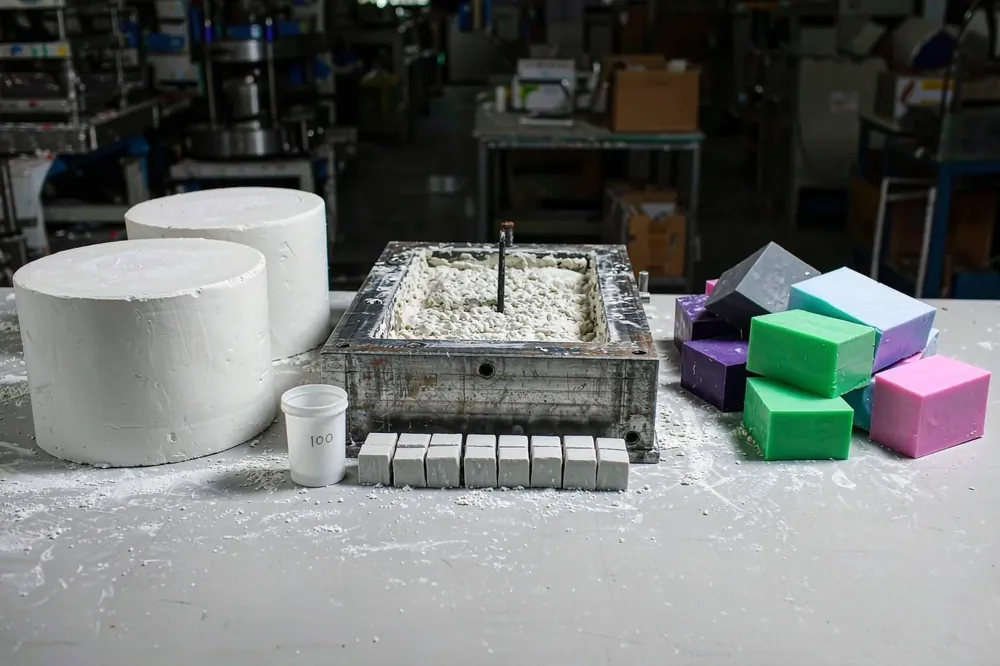
Most silicone sourcing problems — missed tolerances, hidden tooling costs, compliance gaps — trace back to one decision: which supplier you picked. This guide walks through the six checks that separate a reliable factory from a trading company in disguise.
1. Factory or Trading Company?
The single most important question. A trading company adds margin without adding manufacturing control, and its "factory" claims often cannot survive an audit.
- Ask directly: "Are you a factory or a trading company?" A real factory answers without hesitation.
- Check the address: the address on the ISO certificate should match the address on your carton.
- Verify ownership: who owns the molds, presses and QC stations? A trader owns none of them.
- Request a walkthrough: an in-person audit or a live video walkthrough of the molding floor settles it in minutes.
2. Certifications That Actually Matter
Look beyond a logo. Ask for the certificate number, issuing body and expiry — and distinguish a material test from a factory certification.
| Claim | What to verify | Red flag |
|---|---|---|
| ISO 9001 | Certificate number + issuing body + scope | No number, "on request only" |
| ISO 13485 (medical) | QMS scope covers your part category | Showing ISO 9001 only |
| FDA / LFGB | These are material tests, not factory licenses | Implying "FDA-certified factory" |
| BSCI / SEDEX | Audit report + validity window | Expired or unrelated entity |
See how CYES documents this transparently on our quality documents page — every claim linked to a certificate, scope and issuer.
3. Mold Ownership and Tooling
Who owns the mold after you pay for it? A supplier that keeps your tooling hostage controls your supply chain forever.
- Confirm molds are customer-owned and customer-segregated.
- Confirm tooling is transferable on written request.
- Ask about mold steel and expected shot life before you commit — P20, NAK80, S136 and H13 deliver very different lifespans.
4. MOQ Economics — Don't Chase "MOQ 100"
An unrealistically low MOQ usually hides a cost somewhere: order consolidation across buyers, a soft prototype mold that degrades after a few hundred cycles, or tooling cost buried in a 2–3× unit price.
A realistic MOQ is the volume at which a dedicated steel mold, a clean press cycle and per-batch testing are amortized without inflating your unit price.
Ask for price brackets at 500 / 1,000 / 5,000 so you can compare unit economics, not just the MOQ number.
5. Process Capability, Not Just a Machine List
A CMM in the photo is not proof of precision. Ask for the numbers that prove repeatability: Cpk / Cp values, first-article inspection reports, and tolerance plans confirmed in DFM.
- Finished part tolerance vs. mold cavity accuracy are different things — make sure the supplier distinguishes them.
- Ask whether a DFM review flags wall sections, corner radii and Shore-A conflicts before you pay for tooling.
6. Communication and the Engineering Desk
The best supplier answers your first email with engineering questions, not a quote. A reply that flags "this wall will trap air" or "this radius is under-toolable" is worth more than a fast price.
- Do replies come from an engineer or a sales form?
- What is the stated reply time? (CYES targets ≤ 24 business hours.)
- Will they sign an NDA before you share drawings?
Your Six-Point Supplier Checklist
| # | Check | Pass mark |
|---|---|---|
| 1 | Factory or trader? | Auditable floor, address matches certificate |
| 2 | Certifications | Numbers + issuer + scope, material vs. factory distinguished |
| 3 | Mold ownership | Customer-owned, segregated, transferable |
| 4 | MOQ economics | Tiered pricing, no hidden tooling markup |
| 5 | Process capability | Real Cpk data, DFM before tooling |
| 6 | Engineering desk | Engineer reply ≤ 24h, NDA standard |
Ready to run the checklist against CYES? Send your project for review — an engineer will reply within one business day.